
Kratom Research
 Click here to Print the Page
Current sort has key articles at the top. Click on "Article Date" to sort by date, click on specific "tag" to view all articles in that category.
| Title/Link | |
|---|---|
|
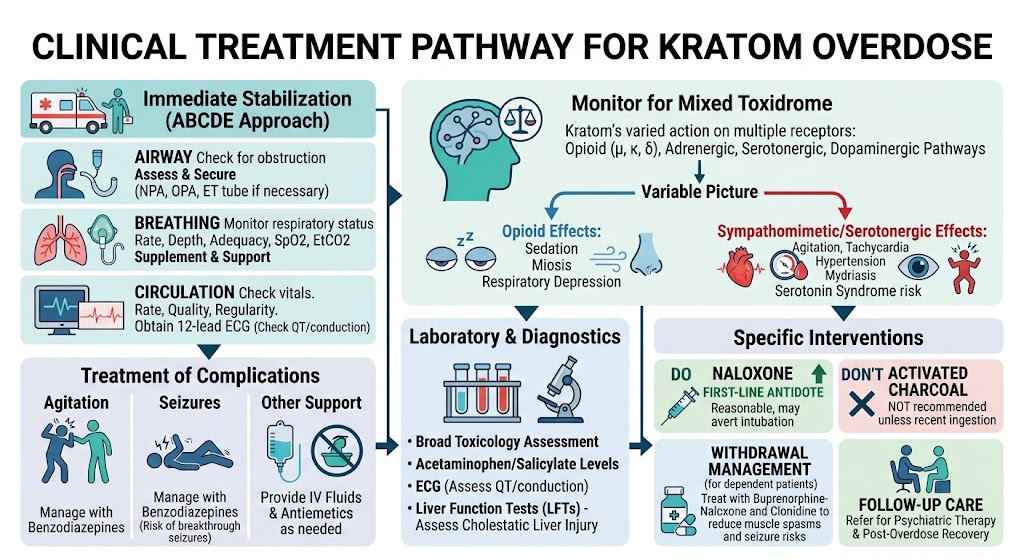
Kratom (Mitragynine) Toxicity: What Paramedics Need to Know 11/17/2026 |
The evidence is overwhelming, and the law is clear. Under 21 U.S.C. § 812(b)(1), a Schedule I placement requires demonstrating a high potential for abuse, no currently accepted medical use in treatment in the United States, and a lack of accepted safety for use under medical supervision. The primary psychoactive alkaloids, mitragynine and 7-hydroxymitragyine act as partial and full agonists at the m-opioid receptors. 7-OH-MG exhibits higher potency at -opioid receptors than morphine, driving compulsive redosing, escalating tolerance, and physiological dependence. There is no accepted or approved medical use, and abrupt cessation in dependent individuals precipitates a classic opioid withdrawal syndrome. Kratom Research, kratom |
|
Kratom Involved in More Than 5,000 Overdose Deaths Since 2020 as Gas Station 7-OH Products Face Federal Scrutiny 11/17/2026 |
Death Counts and the Families Behind Them kratom, Kratom Research |
|
Severe Kratom Withdrawal Induced by Oral Naltrexone: A Case Report and Call for Increased Awareness 10/25/2026 |
Background: Kratom is an illicit substance that has binding affinity to opioid receptors in high doses. Naltrexone is an opioid antagonist used for treatment of alcohol dependence; however, a 7- to 10-day washout period is required to avoid severe withdrawal in opioid users. There is currently no warning regarding concurrent kratom use in naltrexone prescribing information. kratom, withdrawal, Kratom Research |
|
Defining kratom: evidence-based policy guidelines for a rapidly evolving market 10/22/2026 |
kratom, Kratom Research |
|
Kratom Is an Opioid 10/18/2026 |
Over the past century, new opioids have repeatedly been introduced with claims that they are fundamentally different from existing opioids and therefore safer or less addictive. Such claims have shaped clinical practice and regulatory policy, sometimes with profound negative public health consequences. One of the earliest examples followed Bayer’s introduction of heroin in the late 19th century, when company scientists claimed it was a safer, nonaddictive alternative to morphine. kratom, opioid, Kolodny, Kratom Research |
|
Increases in Kratom-Related Reports to Poison Centers — National Poison Data System, United States, 2015–2025 09/06/2026 |
kratom, CDC, MMWR, Kratom Research |
|
An exploratory study of the safety profile and neurocognitive function after single doses of mitragynine in humans 12/17/2024 |
Conclusion: The present study suggests that low doses (5-10 mg) of mitragynine may cause subjective feelings of stimulation and enhance attention, while the highest dose (40 mg) may cause inhibitory feelings of amnesia and distress. Mitragynine doses up to 40 mg were well tolerated in this group. kratom, Kratom Research |


Select language then click on Translate